
The 7th of April marks the formal launch of the UK’s newly established Fair Work Agency (FWA). Aiming to ‘protect workers and level the playing field for businesses’, the FWA will bring together two enforcement bodies, the Gangmasters and Labour Abuse Authority and the Director of Labour Market Enforcement and will take on additional responsibilities around enforcement of the minimum wage (previously within HMRC) along with holiday pay and statutory sick pay.
The incoming head of the FWA Matthew Taylor, who led the widely criticised Review of Modern Working Practices in 2016, has already raised some concerns that the FWA is seeking to reduce rather than increase regulation, but the government has been keen to set out a more assertive approach to enforcement:
“From using new powers to ensure the estimated 900,000 people who have holiday pay withheld each year finally receive it, to cracking down on those employers failing to pay the minimum wage, the Fair Work Agency will finally bring the ambition needed to properly tackle worker exploitation in the UK. “
The withholding of holiday pay is estimated to cost workers around £2.1bn per year, and in 2024 more than 500 employers were ordered to pay back around £16m to workers for minimum wage breaches. This however is likely to be a significant underestimate of the scale of unpaid wages in the UK which cuts across occupational and sectoral lines.
The FWA will be able to issue civil ‘Notices of Underpayment’ as well as compulsory labour market enforcement orders that can result in fines or imprisonment. The FWA can bring Employment Tribunal (ET) proceedings on a worker’s behalf while also issuing penalty fees and recovering the costs of enforcement.
These changes are long overdue as the UK’s enforcement regime has tended to be reactive, rather than proactive, and the fragmentation of responsibilities across multiple agencies has led to significant gaps in protection for workers.
Crucially, there is also significant scope for a co‑enforcement approach with the FWA working in partnership with trade unions to support proactive inspections and drawing on advice‑based and civil society organisations (CSOs) to help triage and refer cases.
These changes to enforcement in the UK raise two main questions. First, is the FWA ready to take on the existing responsibilities of multiple enforcement agencies along with the duty to enforce the new rights and standards set out in the Employment Rights Act? Second, do civil society organisations across the UK have the ‘on the ground’ capacities and incentives to form an effective part of this co-enforcement approach?
Turning to the first question, there have been various attempts to relabel and rebrand enforcement agencies in the UK usually in response to specific incidents such as the Morecambe Bay disaster of 2004, or policy changes such as the introduction of the 2015 modern slavery act. However, the UK has consistently had low numbers of inspectors to cover a large and geographically dispersed workforce, and details of the FWAs staffing strategy are yet to be published. A report by the Resolution Foundation showed that in 2023 there were just 0.29 inspectors per 10,000 workers which is among the lowest in the OECD and far below the ILO benchmark of 1 per 10,000.
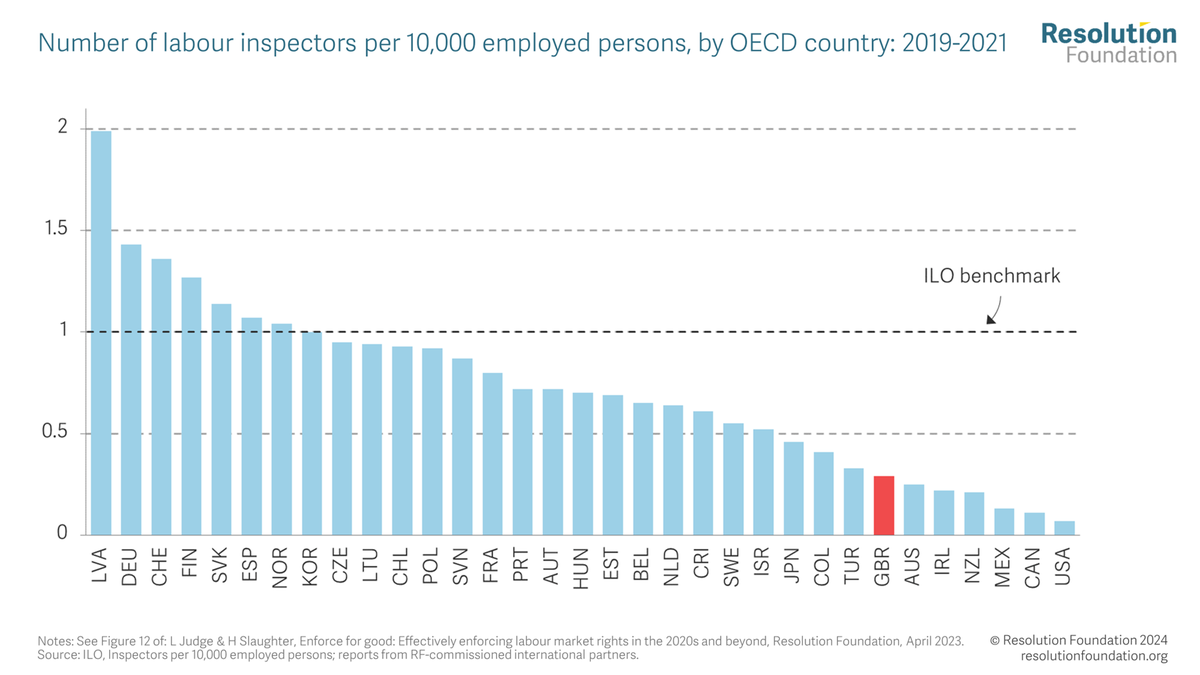
Standardising the aims and approach of the FWA will naturally take time, but recruiting more inspectors has to be an urgent priority, along with establishing greater clarity around their role and remit. Following significant cuts to funding and jobs under conditions of austerity after 2010 inspectors are increasingly deskilled and demotivated, and waves of policy change have led to a significant blurring of responsibilities across labour market issues, health and safety, immigration and organised crime.
The FWA aims to move away from reactive enforcement to proactive strategic compliance and prevention driven by intelligence. While there is a risk that everyday and routine exploitation may be missed this approach is important to tackle egregious breaches particularly as current penalties are highly variable.
For example, the Health and Safety Executive (HSE) can initiate court proceedings that lead to imprisonment and unlimited fines for serious breaches, although typical fines are around £145,000. In contrast, HMRC has historically been reluctant to impose the maximum fine of £20,000 per worker for minimum wage breaches and hopes that the negative publicity of being ‘named and shamed’ will ensure that businesses pay what they owe.
Cases of discrimination and unfair dismissal often rely on worker awareness of their rights, and their capacities to take a claim to an Employment Tribunal. However, many workers find that even if an ET rules in their favour, firms may refuse to pay or simply go into liquidation and dispose of all their assets before re-emerging as a new firm – a practice known as ‘phoenixing’. A recent report by the Bureau of Investigative Journalism revealed that three quarters of people who have gone to government's enforcement scheme (following a successful employment tribunal award) have not still seen their money. Many more workers never make it to a tribunal as they cannot access suitable legal advice and representation or are encouraged to settle quickly via ACAS mediation.
The FWA will be able to take tribunal cases on behalf of workers, but little is known about how recovery mechanisms will work, and what happens if employers ignore ‘notices of underpayment’ or ‘labour market enforcement orders’. Alongside expanded labour rights and enforcement mechanisms, the government also needs to close corporate loopholes that allow firms to be dissolved and re-constituted with different directors in order to avoid fines and liabilities. There are also complex issues around bogus self-employment where individuals miss out on minimum wages, sick pay, holiday pay, and pensions (and may not pay the correct amount of tax), because they are registered as independent contractors. The challenge for the FWA is that while these contractors may receive most of their work from a single client (such as a construction firm, a ride hailing platform, or a hairdressers) there may not be a formal contract of employment to enforce.
Turning to the second question, there are complex and potentially contradictory relationships between state agencies and CSOs. In contrast with some countries where trade unions play an active role in monitoring compliance with employment law, health and safety rules, and collective agreements, unions in the UK have only been sporadically involved in enforcement activities, typically through localised ‘task-forces’ and ‘crackdowns’ aimed at high risk industries. This in turn has revealed complex issues around whistleblowing among vulnerable groups who may fear reprisals from their employer (or gangmaster) or that inspectors will be more concerned with identifying visa and migration breaches rather than labour law breaches.
Our previous research has shown that civil society organisations (CSOs) in the UK provide crucial everyday support to individuals on the margins of the labour market - such as welfare guidance, legal support and employability training – but their ability to campaign, mobilise and organise around broader labour market injustice is constrained by complex funding dependencies, legal restrictions on political activities, and reduced capacity as a result of more than a decade of austerity.
The FWA could leverage the significant expertise and community networks of trade unions and CSOs, but individual organisations are often isolated and disparate, even within local labour markets, and may find themselves competing with each other for resources, and access to policy makers. Recent research that we undertook with various civil society organisations in Greater Manchester also revealed that many CSOs are already at capacity with existing referrals and would struggle to take on any more clients without a significant expansion of funding and staffing. International evidence suggests that critical to the success of a co-enforcement approach is building trust between diverse stakeholders as well as building legitimacy with workers which requires sustained investment in formal institutional structures such as labour standards boards.
A risk of this co-enforcement approach is that by bringing in more civil society support, the FWA itself shoulders less of the responsibility for actual enforcement. Similarly, using CSOs as a ‘trojan horse’ to access individual employers and groups of vulnerable workers may damage the independence and legitimacy of CSOs built up over many years. Ultimately the FWA needs automatic entry and inspection powers in order to protect vulnerable workers and prevent exploitation at source.
The launch of the FWA is an important symbol of the government’s commitment to raising and enforcing decent minimum standards in the labour market, and ensuring that workers, individually and collectively, have recourse to justice. But beyond a simple rebrand of existing agencies, the FWA needs to rapidly restore the internal capacities of the state to enforce labour market rules, while harnessing the distinct knowledge, expertise, and networks of a range of actors.